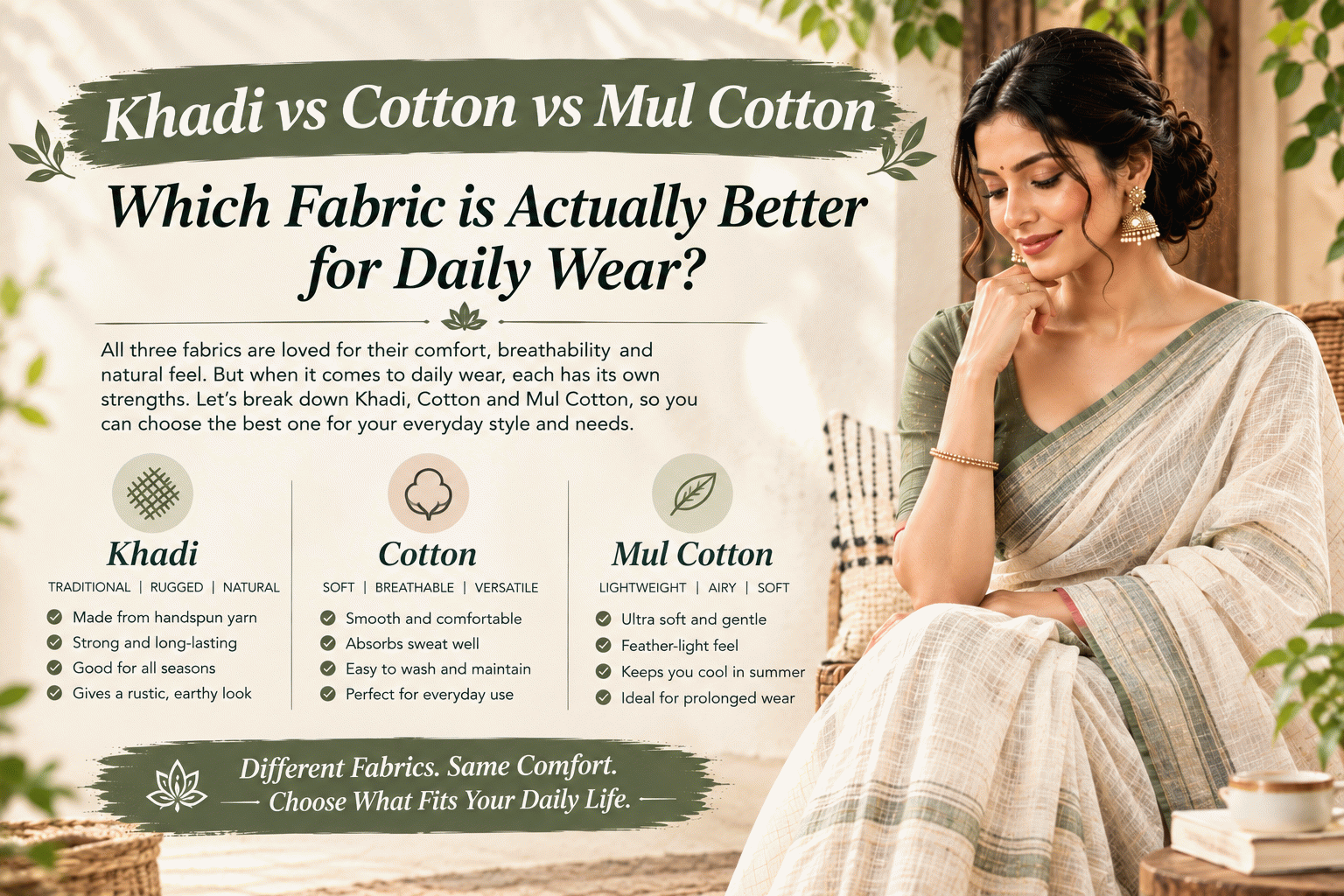
Khadi vs Cotton vs Mul Cotton – Which Fabric is Actually Better for Daily Wear?
Three fabrics. All natural. All cotton-based. All loved by Indian women. But completely different in how they feel, how they breathe, how they look, and what they are best used for.
Khadi, cotton, and mul cotton — these three words appear constantly in saree descriptions and fabric labels across India. And yet most women — even those who have worn all three — are not entirely sure what makes each one distinct, which is actually better for summer, and which one they should be reaching for on a regular workday morning.
This blog settles all of it. Clearly, honestly, and completely — with real fabric facts, real price information from Mznari’s own collection, and a simple final answer to the question everyone is actually asking.
First — What is Khadi Cotton? (Khadi Cotton Kapda Kaisa Hota Hai)
Khadi cotton is cotton fabric that is hand-spun and hand-woven — every step of its production is done by human hands, without any machine involvement.
Here is what that means in practice. Regular cotton fabric — the kind you find in most sarees labelled simply as “cotton” — is made using machine-spun yarn. Machines take raw cotton, clean it, straighten it, and spin it into perfectly uniform, smooth, tightly twisted thread at high speed. That thread is then typically woven on a power loom — again by machine — into fabric.
Khadi cotton does both of these steps differently. The raw cotton is cleaned and straightened by hand, then hand-spun into yarn on a charkha — a spinning wheel operated by a person, not a machine. The yarn produced this way is slightly uneven, slightly thicker in some places and thinner in others, with a natural organic irregularity that machine spinning cannot replicate. That hand-spun yarn is then hand-woven on a traditional handloom — where a weaver controls every thread by foot and hand.
The result is a fabric with a distinctive, slightly textured surface. The slight unevenness of the hand-spun thread creates small natural variations in the weave that give khadi cotton its characteristic look and feel — not perfectly smooth like machine-made cotton, but textured, organic, and genuinely unique. No two khadi cotton sarees are exactly identical, because no two hand-spun, hand-woven pieces of fabric ever are.
Khadi cotton also has a special quality that is directly related to the open, hand-spun weave: it is naturally temperature-regulating. The slightly loose, organic weave creates tiny air pockets in the fabric that help insulate the body — keeping it cooler in summer and slightly warmer in mild winter. This is not a marketing claim. It is a physical property of the open-weave structure that machine-made fabrics do not have.
What is Regular Cotton Saree Fabric?
When a saree is labelled simply as “cotton” or “handloom cotton,” it typically refers to cotton yarn that is machine-spun but then woven on a handloom. The yarn is uniform and machine-made, but the weaving is done by hand. This is sometimes called “power loom cotton” when both spinning and weaving are machine-done.
Regular handloom cotton sarees — woven by hand from machine-spun yarn — are a middle ground. They have the natural feel of cotton fibre and the structural variation of handloom weaving, but without the additional texture and temperature-regulating quality that comes specifically from the hand-spinning process of khadi.
For daily wear, regular handloom cotton is comfortable, breathable, and easy to maintain. It is lighter and softer than many khadi cotton sarees because the machine-spun yarn is smoother and more uniform. The trade-off is that it does not have the distinctive texture, cultural depth, or natural temperature management of genuine khadi cotton.
What is Mul Cotton — And How is it Different from Both?
Mul cotton — also called mulmul or muslin cotton — is a specific weave style rather than a production process. It is woven from very fine, thin cotton threads in a very open, very loose weave — creating a fabric that is ultra-lightweight, extremely soft, and almost sheer.
The key difference between mul cotton and khadi cotton is this: khadi is defined by how the yarn is made (hand-spun). Mul cotton is defined by how thin the yarn is and how loosely it is woven. A mul cotton saree can be made from machine-spun yarn (making it just plain mulmul cotton) or from hand-spun yarn (making it a khadi mul cotton — which combines both qualities).
Mul cotton is the softest and lightest of the three fabrics. When you hold a good mul cotton saree, it weighs almost nothing. It feels like a second skin when draped — extraordinarily gentle, fluid, and barely-there. This is why mul cotton is consistently the most popular daily wear saree fabric in India, particularly in summer.
Khadi mul cotton — hand-spun yarn woven in the open mul cotton style — is the most premium and most cherished combination. It has the lightness and softness of mul cotton combined with the texture, temperature management, and handcraft quality of khadi. Several sarees in the Mznari collection are khadi mul cotton — the Mitti Sehaj, Geheri Halki, and others in the Sehaj collection.
Khadi vs Cotton vs Mul Cotton — The Direct Comparison
Now that we understand what each fabric is — here is the honest, direct comparison across every criterion that matters for daily wear.
Feel on the Skin
Mul cotton wins clearly. It is the softest of the three — the fine, loosely woven threads create a fabric with an almost silk-like softness against the skin. No roughness, no stiffness, nothing but gentleness.
Regular cotton is soft and comfortable but has a slightly more structured, slightly less fluid feel than mul cotton. It is not rough — it is simply more present against the skin than mul cotton.
Khadi cotton has a distinctly textured surface from the hand-spun yarn. The slight unevenness of the thread creates a fabric that some women find slightly rougher than plain cotton — particularly when new. Most khadi cotton sarees soften considerably with repeated washing and wearing. After 5 to 10 washes, a good khadi cotton saree has a much softer feel than it did when new.
Breathability and Comfort in Indian Summer
This is the most searched question about these fabrics — and the answer has important nuance.
Mul cotton is the most breathable for extreme Indian summer heat. The ultra-fine, ultra-loose weave of mul cotton allows the maximum amount of air to pass through the fabric. In 40°C+ temperatures with high humidity, mul cotton keeps the wearer significantly more comfortable than any other cotton fabric. The fabric does not cling, does not trap heat, and dries almost instantly when damp with perspiration.
Khadi cotton is genuinely good for summer — and in some ways better than regular machine-spun cotton for summer comfort. The hand-spun yarn creates natural air pockets in the weave that help the fabric breathe better than machine-made cotton of comparable weight. The temperature-regulating quality of khadi — cool in summer and slightly warm in mild winter — is a real physical property, not marketing language.
However — khadi cotton is generally slightly denser and heavier than mul cotton, which means it is not as extreme-heat-friendly as the ultra-light mulmul. For temperatures between 30°C and 38°C, khadi cotton is very comfortable and breathes well. For peak summer above 38°C, mul cotton wins.
Regular cotton falls in the middle — more breathable than synthetic fabrics by a wide margin, but not as extreme-heat-optimised as either khadi or mul cotton at their best.
Is Khadi Cotton Good or Bad — The Honest Answer
Khadi cotton is very good — but for specific things. Here is what it is genuinely excellent for and what it is less suited to:
Khadi cotton is excellent for: Formal office wear, professional settings, and situations where a structured, polished, dignified appearance is needed. The natural texture of khadi looks intentional and authoritative — it communicates a considered, thoughtful personal style. It is also excellent as a year-round fabric — comfortable in summer, warm enough for mild winters.
Khadi cotton is less ideal for: Peak summer heat above 38°C (where mul cotton is more comfortable), situations where a very smooth, flat surface fabric is expected (where regular cotton is more conventional), and first-time buyers who expect the softness of mul cotton (new khadi can feel slightly rougher).
Is khadi cotton good for summer? Yes, with a qualification. For India’s extreme summer heat — 40°C+ and high humidity — mul cotton is more comfortable. For a comfortable summer experience in temperatures between 25°C and 38°C, including air-conditioned offices, khadi cotton is excellent and very wearable.
Appearance and How It Looks When Worn
Khadi cotton looks the most elevated and most professional of the three. The natural texture gives it a visual richness and depth that plain cotton does not have. In a formal setting, a khadi cotton saree looks like a deliberate, considered choice — it has the quiet authority of a well-made fabric.
Regular cotton looks clean, neat, and appropriately casual or semi-formal depending on the colour and design. It is versatile but does not have the distinctive visual quality of either khadi or mul cotton.
Mul cotton has its own distinctive visual quality — it has a soft, slightly sheer, flowing quality that looks effortlessly elegant. The fabric catches light gently and drapes beautifully. In light and pastel colours especially, mul cotton has a luminous, feminine quality that is very beautiful.
Durability and How the Fabric Ages
Khadi cotton is the most durable of the three. The hand-spun yarn, though slightly uneven, is actually very strong — and khadi gets better with age. Repeated washing gradually softens the hand-spun fibres, and a khadi saree you have owned for two years is noticeably more comfortable and more beautiful than it was when new. Many women own khadi sarees they have worn and washed regularly for five to seven years that still look and feel excellent.
Regular cotton is durable and handles repeated washing well, but does not have the same improvement-with-age quality as khadi. It holds its quality over time without necessarily becoming better.
Mul cotton is the most delicate of the three — the ultra-fine threads in the open weave are more susceptible to damage from harsh washing or rough handling. With gentle care (hand wash, cold water, shade drying), a mul cotton saree lasts very well. With rough treatment, it can weaken or develop holes at stress points. Of the three, mul cotton requires the most careful care to maintain its lifespan.
Price Comparison at Mznari
Mul cotton sarees at Mznari — starting at ₹799. The Sehaj Mul Cotton collection includes the Mitti Sehaj, Tota Sehaj, Saleti Sehaj, Gulabi Sehaj, and others — all at very honest prices with 5.5 metres of saree and 0.9 metres blouse fabric included.
Shop: Mul Cotton Sarees at Mznari
Khadi cotton sarees at Mznari — starting at ₹800 for plain styles. The Lehar Collection of khadi cotton sarees with zari work starts at ₹2,199 (on clearance from ₹4,999) — including the Firozi Lehar, Geheri Laal Lakeer, Neeli Lehar, Laal Lakeer, and Wine Lakeer styles.
Shop: Khadi Cotton Sarees at Mznari
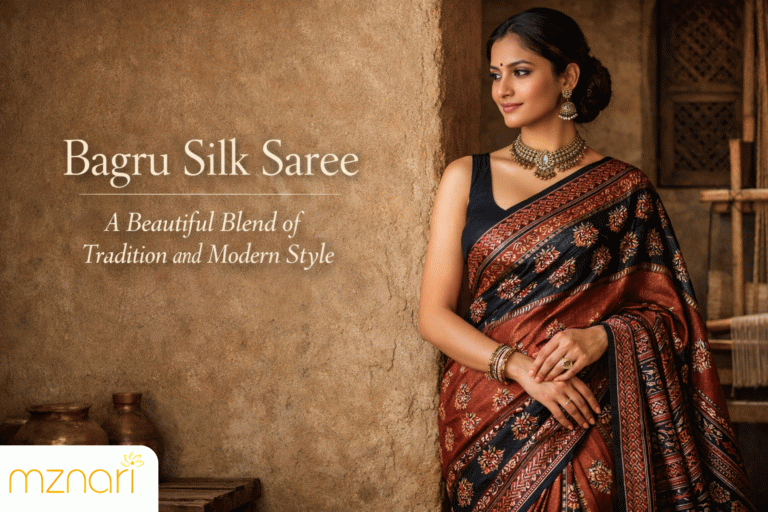
Khadi mul cotton sarees at Mznari — the combination of khadi and mul cotton in one saree. The Geheri Halki Mul Cotton Bagru Saree and others in the collection bring together both qualities. Starting at ₹799.
Shop: All Sarees at Mznari
Khadi vs Cotton vs Mul Cotton — Which Should You Buy?
Here is the most honest and most direct answer to this question, broken down by your specific need:
Buy Mul Cotton if: You wear sarees every single day and comfort is your absolute priority. You live in a hot and humid city. You are new to wearing sarees and want the most forgiving, easiest fabric. You want to build a rotation of affordable, comfortable daily wear sarees. Starting at ₹799 at Mznari.
Buy Khadi Cotton if: You want a saree that looks polished and professional for office wear. You value Indian craft tradition and want your clothing to reflect that. You want a fabric that gets better with every wash and lasts for years. You wear sarees in mixed-temperature conditions — not just extreme summer. Starting at ₹800 at Mznari.
Buy Khadi Mul Cotton if: You want the best of both worlds — the softness and lightness of mul cotton combined with the texture and handcraft quality of khadi. This is the most premium everyday saree option. Look for sarees specifically described as “khadi mul cotton” in Mznari’s Sehaj and Bagru collections.
Buy Regular Handloom Cotton if: You want a versatile, structured daily wear saree that is comfortable without the specific qualities of either khadi or mul cotton. Regular handloom cotton is the most widely available and most conventional choice for everyday sarees.
Khadi vs Linen vs Cotton — Quick Comparison for Women Who Want All Three Answered
Many women search for this three-way comparison — so here is a direct answer:
Khadi cotton — handspun and handwoven. Slightly textured. Best for formal office wear and year-round daily use. Gets better with age.
Linen — made from flax plant fibre (not cotton). Slightly crisp and structured. Best for modern professional settings and semi-formal daily wear. Has the most natural lustre of the three. Starting at ₹900 at Mznari.
Cotton (regular/mul) — machine or hand-spun, various weaves. Softest and lightest in mul cotton form. Best for casual daily wear and extreme summer heat. Most affordable option.
Which is best? For pure summer comfort — mul cotton. For office polish — khadi or linen. For the most modern professional look — linen. For year-round versatility — khadi.
Shop Linen Sarees at Mznari → mznari.com/product-category/linen/
Real Mznari Products — Cotton, Khadi, and Mul Cotton Daily Wear Sarees
Here are specific Mznari sarees that represent each fabric at its best:
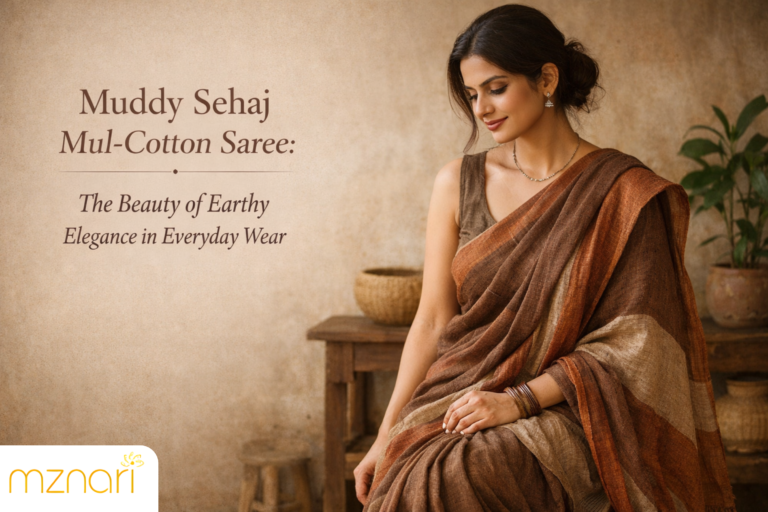
Mul Cotton Daily Wear — Mitti Sehaj Mul Cotton Saree A beautifully made mul cotton saree in a warm earthy mitti (clay) tone. Feather-light, extremely soft, and perfect for daily wear. The Sehaj collection at Mznari represents the best of pure mul cotton craftsmanship. Price: Starting ₹799 Shop: Mitti Sehaj Mul Cotton Saree at Mznari
Khadi Cotton with Zari — Neeli Lehar Khadi Cotton Saree A beautiful khadi cotton saree in a rich blue with the characteristic Lehar (wave) zari detail. The natural texture of khadi is evident in how the saree holds its shape and drapes with quiet authority. Price: Starting ₹2,199 (clearance from ₹4,999) Shop: Neeli Lehar Khadi Cotton Saree at Mznari
Khadi Cotton Plain — Laal Lakeer Khadi Cotton Zari Saree A deep red khadi cotton saree with a structured zari line — classic, traditional, and beautiful for festive and formal occasions. Price: Starting ₹2,199 (clearance) Shop: Laal Lakeer Khadi Cotton Zari Saree at Mznari
Khadi Mul Cotton Bagru — Geheri Halki Mul Cotton Bagru Saree The combination of khadi mul cotton fabric and Bagru hand block printing — the most artisanal and most beautiful of the everyday saree options. Earthy print on the lightest khadi weave. Price: Starting ₹799 Shop: Geheri Halki Mul Cotton Bagru Saree at Mznari
Frequently Asked Questions (FAQ)
- What is the difference between khadi and cotton? All khadi is cotton, but not all cotton is khadi. The difference is in the production process. Khadi cotton is hand-spun (using a charkha) and hand-woven on a traditional handloom — the entire process is done by human hands. Regular cotton fabric uses machine-spun yarn, sometimes woven by hand (handloom cotton) and sometimes by machine (power loom cotton). Khadi has a slightly textured surface, is temperature-regulating, and gets better with age — qualities that come directly from the hand-spinning process.
- Is khadi cotton good for summer? Yes — khadi cotton is genuinely good for summer. The open, hand-spun weave creates natural air pockets that help the fabric breathe and regulate body temperature. For temperatures between 25°C and 38°C, khadi cotton is comfortable and cool. For extreme heat above 38°C, mul cotton is slightly more comfortable due to its ultra-fine, even lighter weave.
- Is khadi cotton good or bad? Khadi cotton is very good — but for specific uses. It is excellent for formal office wear, year-round daily use, and anyone who values Indian craft tradition. The initial slight roughness of new khadi softens with washing and the fabric gets better with age. It is not ideal for extreme summer heat where mul cotton is more comfortable, but for most daily wear situations it is one of the best fabric choices available.
- What is mul cotton? Mul cotton (also called mulmul) is a specific weave style — ultra-fine cotton threads woven in a very open, very loose structure creating an extremely light, extremely soft, semi-sheer fabric. It is the lightest and softest cotton saree fabric available. Khadi mul cotton is the premium version — hand-spun yarn in the mul cotton weave style.
- What is the difference between khadi and mul cotton? Khadi refers to the production process — hand-spun and hand-woven. Mul cotton refers to the weave style — ultra-fine threads in an open, lightweight weave. They are not opposites — a saree can be both khadi and mul cotton (khadi mul cotton) when hand-spun yarn is woven in the light mulmul weave style. Mul cotton is softer and lighter. Khadi cotton has more texture and temperature-regulating qualities.
- Which is better — khadi vs cotton for daily wear? For casual daily wear and extreme summer heat — regular cotton or mul cotton is better because it is lighter, softer, and more breathable. For office and formal daily wear — khadi cotton is better because it looks more polished and professional. For a combination of comfort and craft quality — khadi mul cotton is the best choice for daily wear overall.
- Is khadi and cotton the same? No — khadi and cotton are not the same. Cotton is the raw material (the fibre from the cotton plant). Khadi is a specific production method (hand-spinning + hand-weaving). All khadi is made from natural fibres (usually cotton) — but the defining quality of khadi is the handmade production process, not the raw material itself.
- Where can I buy khadi cotton sarees online in India? Mznari by Manaris offers pure khadi cotton sarees — including the Lehar Collection with zari work starting at ₹2,199 — and mul cotton and khadi mul cotton sarees starting at ₹799 with free shipping, blouse fabric included, and easy 15-day returns. Shop at mznari.com/product-category/khadi-cotton/
Final Thoughts — Three Honest Fabrics for Three Different Moments
Khadi cotton, regular cotton, and mul cotton are not competing for the same moment in your wardrobe. They serve different purposes, different occasions, and different versions of the same daily life.
Mul cotton is for the days when comfort is everything — the long summer Monday, the busy day when you need to feel light and free and easy.
Khadi cotton is for the days when you want to feel dignified and grounded — the important office meeting, the formal occasion, the day when the fabric you wear should communicate that you made a considered, thoughtful choice.
Khadi mul cotton is for the days when you want both — the lightness of mulmul and the craft quality of khadi, together.
All three are available at Mznari by Manaris — honestly made, honestly priced, starting at ₹799 with free shipping and easy 15-day returns.
Shop mul cotton sarees → mznari.com/product-category/mul-cotton/
Shop khadi cotton sarees → mznari.com/product-category/khadi-cotton/
Free Shipping | Easy 15-Day Returns | Blouse Fabric Included | Starting ₹799
Related reads: → Which Saree is Best for Daily Wear – Cotton, Linen, or Khadi? → Best Mul Cotton Sarees for Daily Wear – Soft, Light, and Affordable → Best Khadi Cotton Saree for Office Wear in India → What is Linen Saree – Fabric, Feel, and Why Women Are Obsessed With It → 5 Reasons to Choose Handloom Over Synthetic Saree in 2026