
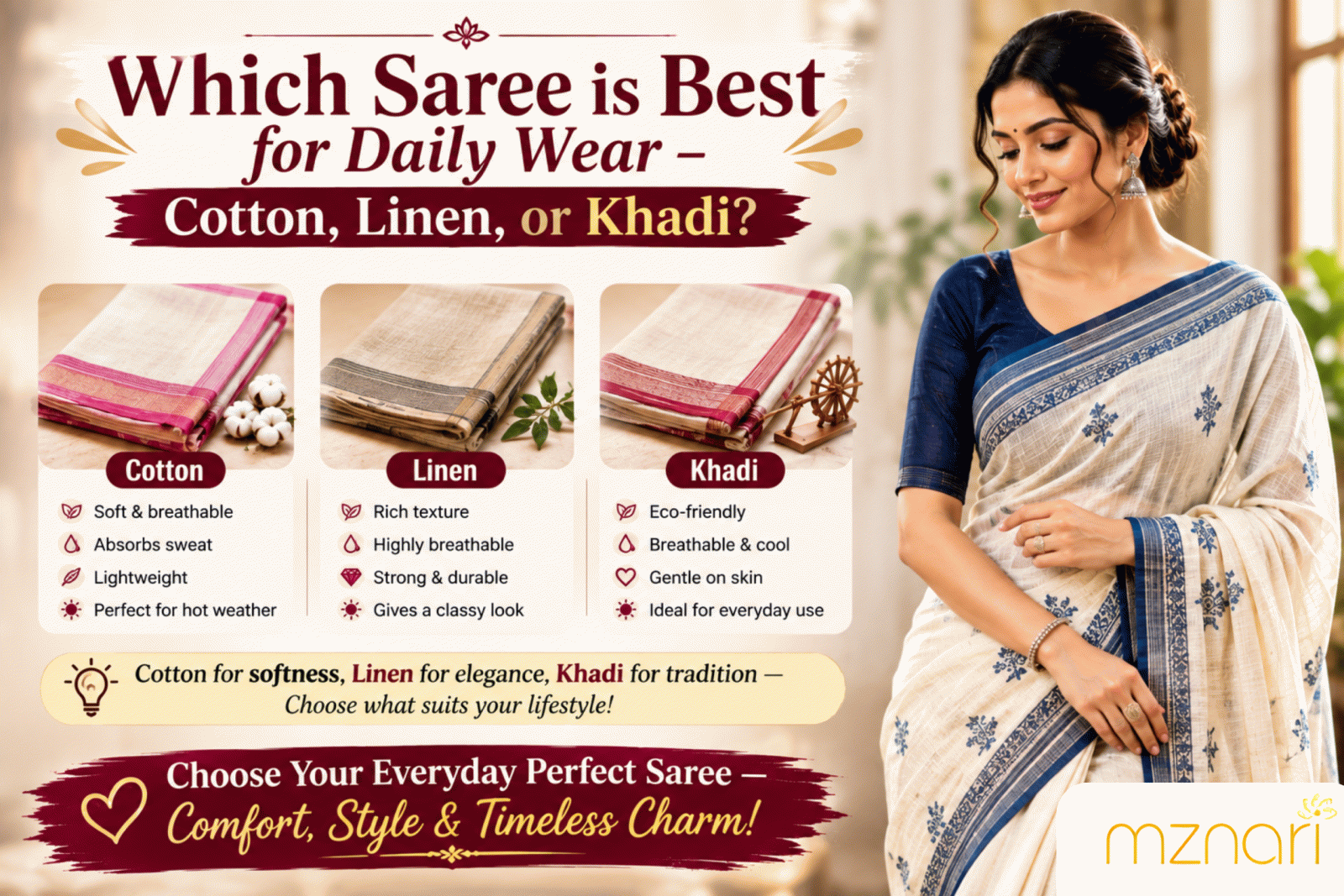
Which Saree is Best for Daily Wear – Cotton, Linen, or Khadi?
This is the most practical saree question in India — and one of the most searched.
Not which saree looks most beautiful at a wedding. Not which fabric is most festive for Diwali. The question every working woman, every teacher, every homemaker, every college student who wears a saree regularly eventually asks — which saree can I wear every day, comfortably, without spending a lot of money or thinking too hard about it?
Cotton, linen, and khadi are the three most popular daily wear saree fabrics in India. All three are natural. All three are handloom-friendly. All three are available at honest prices. But they feel completely different on the body, work differently in Indian weather, and suit different types of women and daily situations.
This blog gives you the complete, honest comparison — so you can stop guessing and start wearing the right saree for your daily life.
The Short Answer — Before the Full Comparison
If you only want a quick answer before reading the full guide:
Mul Cotton is the best daily wear saree for summer, for long wearing hours, for beginners, and for anyone who prioritises absolute comfort above everything else. Starting at ₹799.
Khadi Cotton is the best daily wear saree for office and formal settings, for women who want a more structured and dignified look, and for anyone who values Indian craft and cultural significance in what they wear. Starting at ₹800.
Linen is the best daily wear saree for professional women who want to look more polished and put-together than cotton allows, for women who run slightly warm and need maximum breathability, and for anyone who loves a modern, minimal aesthetic. Starting at ₹900.
Now — the full comparison, so you understand exactly why.
Understanding All Three Fabrics First
Before comparing, a clear understanding of what each fabric actually is — because the names are sometimes used loosely in the market and knowing the real definition helps you buy the right thing.
Cotton saree — the broadest category. Cotton sarees are woven from cotton yarn on a handloom or power loom. Under the cotton umbrella, mul cotton (ultra-fine, loosely woven, extremely light) and regular handloom cotton (slightly firmer, more structured) are the two most relevant for daily wear. At Mznari, the Sehaj Mul-Cotton and Soft Cotton collections cover both these styles.
Khadi saree — a specific type of cotton saree with an important difference. In khadi, the cotton is hand-spun into yarn using a spinning wheel (charkha) before being hand-woven on a handloom. This hand-spinning creates a slightly uneven, textured thread that gives khadi its distinctive surface and feel — no two khadi sarees are exactly identical. At Mznari, the Khadi Lehar collection covers khadi cotton sarees.
Linen saree — made from flax plant fibre, not cotton. Linen is a completely different plant-based natural fibre with its own set of properties — a distinctive natural lustre, slightly rough texture, and exceptional moisture management. Linen sarees at Mznari are available in plain and Bagru print linen styles.
All three are natural fabrics. All three breathe significantly better than synthetic alternatives. The differences are in feel, structure, drape, occasion suitability, and care requirements.
Round 1 — Comfort and Wearability for Long Hours
Mul Cotton wins on comfort by a significant margin. Mul cotton — also called mulmul — is woven from ultra-fine cotton threads in a loose, open weave that makes the fabric feather-light and almost sheer. It weighs almost nothing on the body. It does not cling to the skin even when you perspire. After 10 hours in a mul cotton saree, you feel almost the same as you did when you put it on in the morning. This is why mul cotton is the most worn daily saree fabric across India.
Khadi is comfortable but in a different way. Khadi cotton has a slightly firmer, more structured feel than mul cotton. The hand-spun yarn creates a natural texture that feels more substantial on the body — not heavy, but present. In summer, khadi is comfortable because it breathes well. In mild winter, the slightly denser weave provides enough warmth for cooler weather. Khadi is more of a year-round fabric.
Linen sits between cotton and khadi in comfort terms. Linen’s slightly crisp, structured feel is very comfortable for long office hours because the fabric holds its shape without constant adjustment. However, brand-new linen can feel slightly stiff on the skin — particularly for women with sensitive skin. After 5 to 10 washes, linen softens considerably.
Verdict for comfort: Mul cotton first. Khadi second. Linen third — though linen improves dramatically with age.
Round 2 — Best for Indian Summer Heat
Mul cotton is the undisputed summer champion. The ultra-fine, loosely woven structure allows air to pass through the fabric almost freely. On a 40°C day, wearing a mul cotton saree feels significantly cooler than any other fabric. It does not trap heat. It does not hold moisture. It dries almost instantly when damp with perspiration.
At Mznari, the Sehaj Mul-Cotton collection is specifically designed for this — handwoven by women artisans, made from natural breathable fabric, dyed using skin-safe eco-friendly processes, designed for long comfortable wear in Indian conditions.
Linen is the second-best summer fabric. The hollow structure of the flax fibre creates natural air channels for air circulation, and linen’s moisture absorption and evaporation rate is very high. On a hot day, linen keeps you significantly cooler than most fabrics of comparable weight. The difference from mul cotton is that linen has more body and weight — so on the absolute hottest summer days, mul cotton remains more comfortable.
Khadi is a good summer fabric but not the best. Khadi breathes well and absorbs moisture, but the slightly denser handspun weave is not as airy as mul cotton or a linen-cotton blend in peak heat. Khadi is most comfortable in summer when temperatures are in the 30 to 35°C range.
Verdict for summer: Mul cotton first. Linen second. Khadi third.
Round 3 — Best for Office and Professional Daily Wear
Khadi wins for formal office environments. The natural texture of khadi cotton has a quiet authority and dignity that plain cotton does not replicate. It looks serious and intentional. A deep navy or grey khadi cotton saree with a simple silk blouse is one of the most professional and most flattering office looks a woman can create. In settings like government offices, educational institutions, or law firms — khadi is the best daily wear saree choice.
The Khadi Lehar collection at Mznari features pure khadi cotton with elegant zari work — specifically designed for women who want everyday elegance without effort.
Linen is the best choice for modern professional environments. Creative agencies, corporate offices, design firms, media companies — environments where personal style is appreciated alongside professionalism. Linen’s natural lustre looks more elevated than cotton in office lighting and the structured drape holds neat pleats all day.
Mul cotton is comfortable for office but not the most formal-looking. The very lightness and softness that makes it so comfortable also gives it a slightly casual quality. It is perfectly appropriate for offices with a relaxed dress code, for teachers, and for homemakers. For strict formal settings, khadi or linen is more appropriate.
Verdict for office: Khadi first for formal environments. Linen first for modern professional settings. Mul cotton best for relaxed professional environments.
Round 4 — Price and Value for Daily Wear
Mul cotton offers the most value for daily wear. At Mznari, mul cotton sarees start at ₹799. At this price, you can build a complete 5-saree daily rotation for under ₹4,000. The fabric is durable enough to withstand frequent washing and gets softer with each wash.
Khadi is slightly more expensive but excellent value over time. Khadi sarees at Mznari start at ₹800 — only marginally above mul cotton. Khadi is extremely durable and improves with age and washing. A khadi saree you wash and wear regularly for two years will feel softer and more beautiful than when new.
Linen is slightly more than cotton but worth the premium. Linen sarees at Mznari start at ₹900. Linen’s exceptional durability — stronger than cotton and not degrading with repeated washing — means it holds its quality longer. Over a 3 to 5 year lifespan, a good linen saree is among the best value purchases in any daily wear wardrobe.
Verdict for price: All three are genuinely affordable at Mznari. Mul cotton is cheapest. Khadi marginally above. Linen slightly more. None will stretch a reasonable budget.
Round 5 — Ease of Care for Daily Wear
Mul cotton is the easiest to care for. Hand wash or gentle machine wash in cold water, shake out, hang in shade — dries within a few hours. Mul cotton needs minimal ironing. For a busy woman who wears sarees every day, mul cotton’s care simplicity is a significant practical advantage.
Khadi is easy to care for but needs slightly more attention. Khadi responds very well to a good iron — a medium-heat iron on a slightly damp khadi saree gives it a clean, crisp finish that holds through a full workday. The slightly denser weave dries a little more slowly than mul cotton but is still very manageable.
Linen needs the most care of the three but rewards it. The key to easy linen care is ironing while slightly damp — a hot iron on a slightly damp linen saree gives it a beautifully crisp finish. Once ironed, linen holds its pressed appearance longer than cotton through a workday. The extra ironing step is the main care consideration.
Verdict for care: Mul cotton first. Khadi second. Linen third — though linen rewards proper care with a beautifully polished appearance.
Round 6 — Occasion Range for Daily Wear
Mul cotton covers the broadest range of casual daily occasions. Home, errands, casual office days, college, morning temple visits, casual family visits, travel — mul cotton works beautifully for all of these.
Khadi covers formal and semi-formal daily wear best. Office meetings, formal professional settings, institutional visits, important appointments — khadi looks appropriate in every formal daily situation. A khadi saree with a zari border also crosses over beautifully into small festive occasions.
Linen covers modern professional and semi-formal daily wear. Office, client meetings, professional events, casual lunches — linen covers these with ease. A Bagru print linen also works beautifully for weekend outings and casual cultural events.
Verdict for versatility: Mul cotton is widest for casual occasions. Khadi is widest for formal occasions. Linen sits most comfortably in the modern professional middle.
The Complete Daily Wear Saree Decision Guide
Here is the simplest way to decide which of the three is right for you:
You are a homemaker who wears sarees at home and for daily errands: Mul cotton is your fabric. The lightest, softest, most comfortable for long hours of movement at home and casual outings. Starting at ₹799.
You are a teacher or work in an educational institution: Mul cotton for comfortable all-day wear, or khadi for days when you want to look more formal and authoritative. A mix of both in your rotation covers every school day perfectly.
You are a corporate or government office professional: Khadi for formal meeting days. Linen for regular professional days. Both cover your professional daily wear needs completely.
You work in a creative or modern professional environment: Linen is your primary daily wear fabric — structured and intentional in creative office settings. A Bagru print linen saree on a casual Friday looks completely right. Starting at ₹900.
You are a college student: Mul cotton for every regular college day — light, affordable, easy to manage, and comfortable through long campus hours. Bagru print cotton adds personality for special days.
You travel frequently: Mul cotton — lightest to pack, quickest to dry, easiest to iron, and most forgiving of travel conditions.
You live in a very hot and humid city: Mul cotton without question. Linen is a good second choice for months when temperature drops below 35°C.
You want one saree that works for the most occasions: A plain handloom cotton saree with a contrast border covers casual daily wear, office on relaxed days, casual family functions, and home puja with equal appropriateness.
Building a Complete Daily Wear Wardrobe with All Three
The best daily wear wardrobe does not choose one fabric — it uses all three strategically:
3 mul cotton sarees — for Monday, Wednesday, and Friday. Light, comfortable daily wear in different pastel or soft colours. Starting at ₹799 each.
2 khadi cotton sarees — for Tuesday and Thursday office days, or any formal professional occasion. In deeper, formal colours — navy, grey, forest green, teal. Starting at ₹800 each.
1 linen saree — for the most polished professional day of the week, for client-facing occasions. In a neutral tone or subtle Bagru print. Starting at ₹900.
Total for a 6-saree daily wear rotation covering every type of daily occasion: approximately ₹4,900. Blouse fabric included with every saree. Free shipping on everything.
Shop Mul Cotton → mznari.in/product-category/mul-cotton/
Shop Khadi Cotton → mznari.in/product-category/khadi-cotton/
Shop Linen → mznari.in/product-category/linen/
Colours That Work Best for Each Daily Wear Fabric
For mul cotton daily wear: Light and pastel colours look most beautiful — off-white, pale mint, powder blue, soft pink, warm ivory, sage green, light yellow. For daily office wear, slightly deeper pastels — dusty blue, soft teal, warm lavender — look professional while retaining lightness.
For khadi daily wear: Earthy, natural, and deep tones suit khadi’s textured handspun quality — off-white, warm beige, natural grey, and terracotta for the most organic look. Deep navy, forest green, teal, and burgundy for formal office wear.
For linen daily wear: Muted, sophisticated tones work best — warm beige, dusty sage, stone grey, slate blue, warm ochre, soft terracotta. These complement linen’s natural qualities without competing with the fabric’s texture.
Frequently Asked Questions (FAQ)
- Which saree is best for daily wear in India?
For daily wear in India, mul cotton is the most comfortable and most practical choice — ultra-light, extremely breathable, affordable from ₹799, and easy to maintain. Khadi cotton is the best for formal daily wear in office and professional settings. Linen is best for women who want a polished, structured look for modern professional environments. - Which cotton saree is best for daily wear?
Mul cotton is the best cotton saree for daily wear because it is the lightest and most breathable cotton fabric available. The ultra-fine, loosely woven structure makes it feather-light and extremely comfortable for long hours in Indian heat. Handloom cotton is also excellent, particularly for office settings where a slightly more structured look is preferred. - Is linen or cotton better for daily wear sarees?
For casual daily wear, cotton — particularly mul cotton — is more comfortable in extreme heat and easier to care for. Linen is more appropriate for professional and office settings because its structure and natural lustre look more polished throughout the day. - Which saree fabric is most comfortable for all-day wear?
Mul cotton is the most comfortable saree fabric for all-day wear — lightest, softest, and most breathable. It weighs almost nothing, does not cling to the skin when you perspire, and keeps you cool even in Indian summer heat. - Is khadi saree good for daily wear?
Yes — khadi is an excellent daily wear saree, particularly for formal and office settings. The slight natural texture of handspun khadi cotton looks polished and professional. It is breathable, comfortable for all-day wear, and gets softer with every wash. - What is the best daily wear saree under ₹1000?
At Mznari, mul cotton sarees start at ₹799, khadi cotton at ₹800, and linen at ₹900 — all under ₹1000 with blouse fabric included and free shipping. For most comfortable daily wear under ₹1000, mul cotton is the best value. For most polished office daily wear, khadi cotton is the best choice. - How many sarees does a working woman need for daily wear?
A working woman who wears sarees every day comfortably needs 5 to 7 sarees in rotation — enough that each saree rests between wears, extending its life. At Mznari prices starting from ₹799, a complete 6-saree daily wear rotation across all three fabrics costs approximately ₹4,900 with blouse fabric and free shipping included. - Where can I buy the best daily wear sarees online in India?
Mznari offers the complete range of daily wear sarees — mul cotton (Sehaj Mul-Cotton collection), khadi cotton (Khadi Lehar collection), and linen — all starting at ₹799 with free shipping, blouse fabric included, and easy 15-day returns. Shop at mznari.in/product-category/saree/
Final Thoughts — The Right Daily Wear Saree is the One You Reach for Without Thinking
The best daily wear saree is not the most beautiful one in your wardrobe. It is the one you reach for without thinking on an ordinary Tuesday morning. The one that goes on in five minutes, stays neat all day, keeps you comfortable through every meeting and every errand, and comes off at the end of the day having asked almost nothing of you.
That saree is different for different women. For some it is a feather-soft mul cotton in pale mint. For others it is a dignified navy khadi with a silk blouse. For others it is a structured stone-grey linen that looks polished through a full corporate day.
All three are available at Mznari — handwoven by artisans, made from natural breathable fabrics, dyed using skin-safe processes, designed for long comfortable wear. The Sehaj Mul-Cotton, Khadi Lehar, and linen collections at Mznari are each built for women who want everyday elegance without effort. Starting at ₹799 with free shipping and easy 15-day returns.
Shop daily wear sarees at Mznari → mznari.in/product-category/saree/
Free Shipping | Easy 15-Day Returns | Blouse Fabric Included | Starting ₹799
Related reads: → Best Mul Cotton Sarees for Daily Wear – Soft, Light, and Affordable → Best Khadi Cotton Saree for Office Wear in India → What is Linen Saree – Fabric, Feel, and Why Women Are Obsessed With It → How to Build a Complete Saree Wardrobe on a ₹5000 Budget → 7 Types of Cotton Sarees Every Indian Woman Should Know About → 5 Reasons to Choose Handloom Over Synthetic Saree in 2026