There are sarees that look beautiful. And then there is the Chanderi sari — a saree that looks beautiful, feels extraordinary, and carries 600 years of Indian weaving heritage in every thread.
If you have ever touched a genuine Chanderi saree and felt the semi-sheer, almost weightless fabric slip through your fingers with a whisper of natural silk lustre — you understand immediately why women across India have been wearing and collecting Chanderi for generations. And if you have never tried one, this blog will tell you everything you need to know before you do.
This is your complete guide to Chanderi sarees — what they are, where they come from, the different types available, what makes each one unique, how much they cost, and exactly which style is right for you.
What is a Chanderi Saree — The Complete Answer
A Chanderi sari is a handwoven saree made in Chanderi, a small historic town in Madhya Pradesh approximately 230 kilometres from Bhopal. Chanderi has been a centre of fine textile production for over 600 years — its weaving tradition is documented from the Vedic period, flourished under the Malwa Sultanate, and was patronised by the Mughal court for its extraordinary quality.
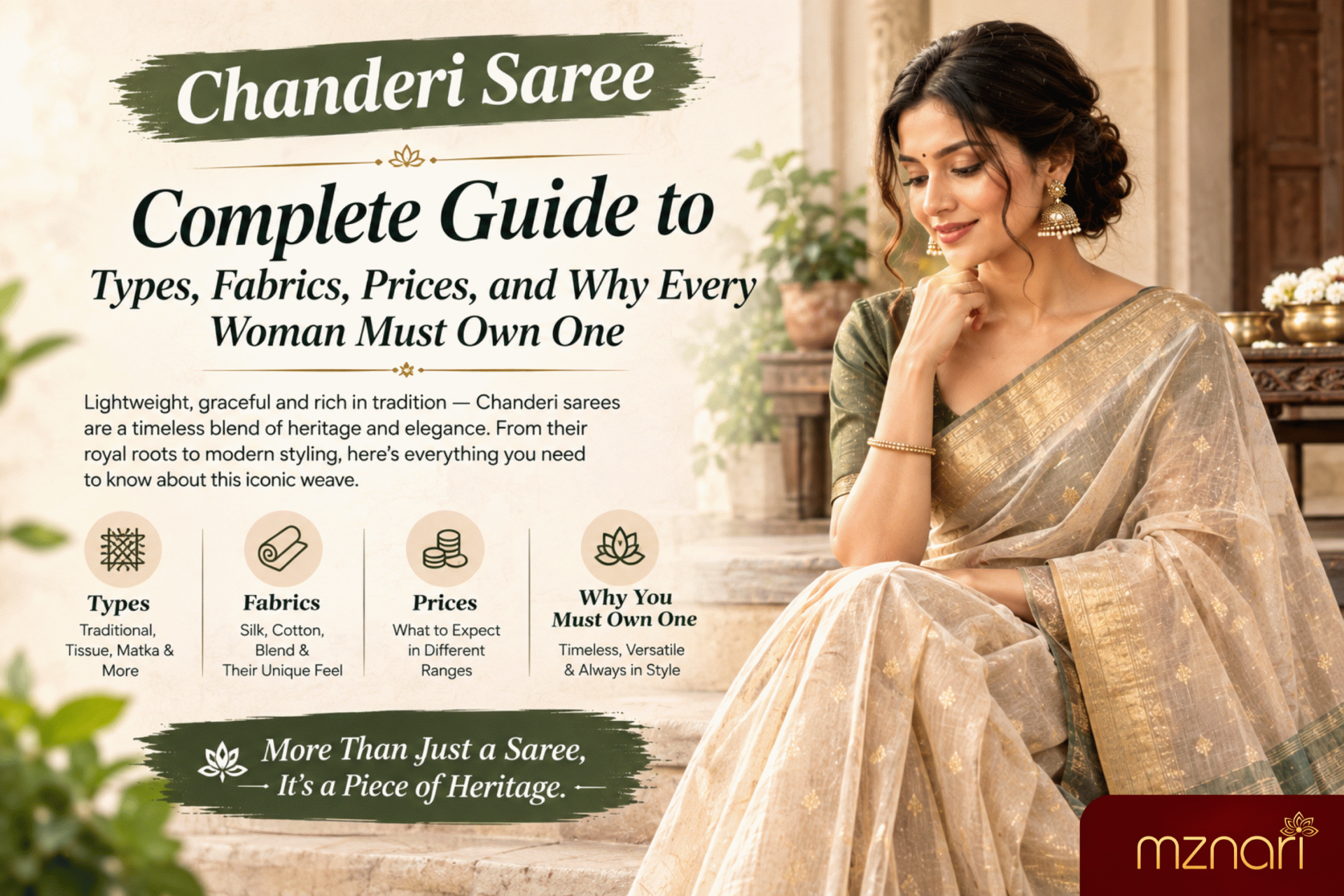
The defining characteristic of a Chanderi saree is its unique fabric — woven from a combination of silk and cotton threads that creates a fabric unlike any other in India. The silk threads give the fabric its characteristic natural sheen and fluid drape. The cotton threads give it breathability, softness, and the lightweight quality that makes it so comfortable for long hours of wear. The result is a semi-sheer fabric with a warm, glowing translucency that no other Indian textile quite replicates.
Chanderi sarees are recognised with a Geographical Indication (GI) tag from the Government of India — meaning only sarees genuinely woven in Chanderi using authentic traditional methods can be called true Chanderi. When you buy a Chanderi sari, you are buying a piece of verified Indian textile heritage.
Shop authentic Chanderi sarees at Mznari → mznari.com/product-category/chanderi/
The Different Types of Chanderi Sarees — A Complete Breakdown
Chanderi sarees are not one single fabric — they come in several distinct types, each with its own composition, appearance, and occasion suitability. Understanding the types helps you choose the right one for your specific need.
1. Chanderi Cotton Saree — The Most Comfortable and Most Wearable Type
The Chanderi cotton saree uses a higher proportion of cotton threads in the weave, with silk threads present but not dominant. This creates a fabric that is lighter, more breathable, and more comfortable for longer periods of wear than a silk-dominant Chanderi.
A Chanderi cotton saree has a softer, slightly more matte finish than its silk-heavy counterpart — but it still has the characteristic Chanderi semi-sheerness and the delicate natural glow that makes Chanderi instantly recognisable. The cotton content makes it more forgiving in India’s warm and humid climate — particularly during the summer months and the monsoon season.
Chanderi cotton sarees are the most popular Chanderi type for daily festive wear, office on special days, daytime wedding functions, and semi-formal occasions where a lightweight, beautiful saree is needed without the heaviness of a pure silk.
Best for: Office on important days, daytime weddings, semi-formal occasions, college functions, festive home occasions, puja days
Colours available: The full range — pastels, jewel tones, earthy neutrals, and traditional combinations
Price at Mznari: Starting ₹1,200
Shop: Chanderi Sarees by Mznari
2. Chanderi Silk Saree — The Most Festive and Most Lustrous Type
A Chanderi silk saree uses a higher proportion of silk threads in the weave — creating a fabric with a more pronounced, richer natural sheen, a slightly heavier drape, and a more obviously festive appearance than a cotton-dominant Chanderi.
The silk content in a Chanderi silk saree gives it a depth and luminosity that makes it the natural choice for evening wedding functions, grand festive occasions, and any event where you want to look genuinely dressed up. Under warm indoor lighting and evening event lighting, a Chanderi silk saree catches and reflects light beautifully — it glows rather than simply reflecting, which is the distinctive quality of genuine silk-woven fabric.
Chanderi silk sarees drape with a more fluid, slightly heavier fall than Chanderi cotton sarees — the pleats are softer and the pallu has a beautiful, weighty flow that looks magnificent in photographs.
Best for: Evening weddings, receptions, major festivals, evening parties, formal festive occasions
Price at Mznari: Starting ₹1,200
Shop: Chanderi Sarees by Mznari
3. Pure Chanderi Silk Saree — The Most Luxurious and Most Exclusive Type
A pure Chanderi silk saree is woven using a very high silk content — the warp and weft both use fine silk threads with minimal or no cotton blending. This creates the most luxurious, most sheer, and most lustrous version of Chanderi fabric.
Pure Chanderi silk sarees are among the finest handloom sarees produced in India. The fabric is exceptionally light despite its silk richness — it almost disappears on the body. The sheen is deep and warm — not the bright, hard shine of synthetic fabrics but the organic, multi-directional glow of genuine silk that looks different and beautiful from every angle.
Pure Chanderi silk saree prices reflect the higher silk content and more complex weaving required. At Mznari, pure Chanderi silk sarees are available at honest prices that make genuine quality accessible.
Pure Chanderi silk saree price at Mznari: Starting ₹1,200 — significantly more affordable than most pure silk alternatives
Best for: Special occasions, evening weddings, bridal trousseau, gift-giving, major festive events
Shop: Chanderi Sarees by Mznari
4. Chanderi Silk Saree with Zari Border — Traditional, Festive, and Timeless
A Chanderi silk saree with zari border is perhaps the most classic and most beloved Chanderi style. In this style, the body of the saree is woven in the characteristic Chanderi silk-cotton blend while the border — and often the pallu — features gold or silver zari (metallic thread) woven directly into the fabric during the weaving process.
The contrast between the delicate, semi-sheer Chanderi body and the rich, structured zari border is one of the most beautiful visual combinations in Indian textile tradition. The body says softness. The border says celebration. Together they create a saree that works equally well for a morning puja and an evening reception.
A Chanderi silk saree with zari border in a jewel tone — deep teal with gold border, emerald green with silver border, rich wine with gold zari — is one of the most versatile festive sarees a woman can own. It photographs magnificently, works for multiple occasions, and never looks dated.
Best for: Weddings, Diwali, Navratri, festive family functions, home puja on auspicious days, Raksha Bandhan
Price at Mznari: Starting ₹1,200
Shop: Chanderi Sarees by Mznari
5. Chanderi Work Saree — Artistry Woven into the Fabric
A Chanderi work saree refers to a Chanderi saree that features traditional woven work — motifs, patterns, or decorative elements created directly in the weave during production rather than printed or embroidered after. This woven work is what distinguishes authentic handloom Chanderi sarees from printed or embellished imitations.
Traditional Chanderi work includes:
Coin motifs (asharfi buti) — small gold or silver coin-shaped woven motifs scattered across the body of the saree. One of the most classic and most recognised Chanderi patterns, the coin buti has been woven into Chanderi fabric for centuries.
Floral motifs — woven flowers, petals, and botanical patterns in silk or zari threads. These range from very small, scattered buti designs to larger, more elaborate floral arrangements across the pallu.
Peacock motifs — the peacock is one of the most traditional motifs in Chanderi work, appearing along borders and in pallu designs in both silk thread and zari.
Geometric patterns — checkered designs, diamond patterns, and geometric borders are also traditional Chanderi work styles, particularly in older regional weaving traditions.
Jaali work — an intricate lattice or net-like woven pattern across sections of the saree that creates a beautiful textural variation against the plain body fabric.
A Chanderi work saree with traditional woven motifs is the most authentic and most collectible Chanderi style — the one that carries the most direct connection to the 600-year weaving tradition of the town.
Best for: Festive occasions, weddings, cultural events, saree collectors, trousseau pieces
Price at Mznari: Starting ₹1,200
Shop: Chanderi Sarees by Mznari
6. Chanderi Print Saree — Contemporary, Artistic, and Beautifully Modern
A Chanderi print saree combines the beautiful Chanderi fabric base with printed surface designs — either hand block printing, screen printing, or digital printing applied to the woven Chanderi fabric after weaving.
Chanderi print sarees are a more contemporary interpretation of the classic style. The characteristic translucency and natural sheen of the Chanderi fabric gives printed designs a depth and glow that the same print on a plain cotton or synthetic fabric cannot achieve. The silk content in the Chanderi base makes colours appear richer and more luminous than on a flat cotton surface.
Block-printed Chanderi print sarees — particularly those using natural dyes in Bagru or Dabu resist printing styles — are especially beautiful. The organic, slightly imperfect quality of hand block printing on the shimmering Chanderi surface creates a saree that is both artisanal and elegant.
Chanderi print sarees are very popular for modern professional women who want the comfort and elegance of Chanderi with more visual interest than a plain woven saree provides. They work beautifully for office wear, casual outings, cultural events, and semi-festive occasions.
Best for: Office, casual outings, cultural events, college, weekend functions, travel
Price at Mznari: Starting ₹1,200
Shop: Chanderi Sarees by Mznari
7. Brown Chanderi Saree — The Most Underrated and Most Sophisticated Colour
The brown Chanderi saree deserves its own section — because brown in Chanderi is not just a colour, it is a statement.
Brown is one of the most underrated saree colours in India. Women gravitate toward jewel tones and pastels and often overlook the extraordinary sophistication of a well-chosen brown. But on a Chanderi sari — with the natural silk lustre catching the warm tones of the brown and making them glow — brown becomes something completely different from what you expect.
A brown Chanderi saree in warm chocolate, rich coffee, earthy sienna, or deep cocoa has a richness and depth that looks more expensive and more sophisticated than many brighter, more obvious colour choices. It has an understated elegance that works beautifully for:
Office and professional settings — a brown Chanderi saree in a warm, deep tone with a cream or gold blouse looks polished, intentional, and completely put-together in any professional environment.
Autumn and winter festive occasions — brown is a natural autumn colour that looks particularly rich during the October to December festive season when warm tones feel most appropriate.
Daytime weddings — a brown Chanderi saree with gold zari work and traditional gold jewellery creates a very sophisticated, non-conventional wedding guest look that stands out elegantly from the more typical jewel-tone choices.
Women with warm dusky or golden-brown skin tones — warm brown tones create a beautiful monochromatic harmony with warm Indian skin tones, making the overall look feel cohesive and deeply beautiful rather than contrasting.
The best blouse colour for a brown Chanderi saree: warm gold, ivory, deep cream, burnt orange, or forest green. Gold jewellery — particularly antique or temple gold — suits brown Chanderi extraordinarily well.
Price at Mznari: Starting ₹1,200
Shop: Chanderi Sarees by Mznari
Pure Chanderi Silk Sarees Price — Honest Guide to What You Pay for What You Get
Pure Chanderi silk saree prices vary significantly across the market — and understanding what determines the price helps you buy wisely.
What drives the price of a pure Chanderi silk saree:
The silk-to-cotton ratio is the primary price driver. More silk means more cost — pure silk thread is significantly more expensive than cotton. A pure Chanderi silk saree with a very high silk content will always cost more than a Chanderi cotton saree of comparable craftsmanship.
The complexity of the woven work is the second price driver. A plain Chanderi saree with a simple border costs less than a Chanderi work saree with elaborate woven motifs, coin buti work, or jaali patterns — the more complex the weave, the more time and skill required from the weaver, and the higher the price.
The quality of the zari is the third factor. A Chanderi silk saree with zari border using real gold or silver zari costs significantly more than one using metallic polyester thread. Real zari maintains its lustre for decades. Metallic polyester tarnishes over time.
Price guide for Chanderi sarees at Mznari:
Chanderi cotton sarees — starting ₹1,200. The most accessible entry point — beautiful Chanderi quality at an honest price.
Chanderi silk sarees with zari borders — starting ₹1,200 upward. The most popular festive Chanderi style.
Pure Chanderi silk sarees with higher silk content and more elaborate work — ₹1,500 to ₹3,500 and above depending on the complexity and silk purity.
At Mznari by Manaris, every Chanderi saree is available at clearance prices starting from ₹799 — with 5.5 metres of saree fabric and 0.9 metres of blouse fabric included, free shipping, and easy 15-day returns.
Shop all Chanderi sarees → mznari.com/product-category/chanderi/
When to Wear Which Chanderi Saree — Complete Occasion Guide
Knowing which type of Chanderi sari suits which occasion makes every decision easier:
Morning puja and temple visits: A Chanderi cotton saree in a soft, auspicious colour — pale yellow, soft green, or off-white — with a simple blouse. The lightweight fabric is comfortable for long puja sessions and looks traditionally appropriate for devotional occasions.
Office on important days: A Chanderi print saree or a plain Chanderi cotton saree in a muted, professional tone — brown Chanderi, dusty sage, slate blue, or warm beige. The natural lustre of Chanderi looks more polished than plain cotton without being overdressed for a workplace.
Daytime wedding functions: A Chanderi silk saree or Chanderi cotton saree in a jewel tone — teal, emerald, deep rose, or wine. Festive enough for a wedding but lightweight and comfortable for an outdoor daytime function in Indian heat.
Evening wedding and reception: A Chanderi silk saree with zari border in a deep jewel tone or a Chanderi work saree with elaborate woven motifs. Under evening lighting the silk sheen glows beautifully — the perfect festive level for an evening wedding event.
Diwali and major festivals: A Chanderi silk saree with zari border in red, gold, emerald, or royal blue with traditional gold jewellery. The combination of Chanderi’s natural festive elegance and the zari border’s richness is one of the most beautiful Diwali looks possible.
Navratri: A Chanderi cotton saree or Chanderi silk saree in the day’s designated colour. Light enough for long Garba nights, festive enough for the occasion.
Cultural events and art exhibitions: A Chanderi print saree — particularly a block-printed or natural dye printed style — looks artistic, intentional, and completely appropriate for cultural settings.
How to Style a Chanderi Saree — Complete Styling Guide
Blouse choice for Chanderi sarees: The delicate, semi-sheer quality of Chanderi sari fabric calls for a blouse that complements rather than competes. For everyday and office Chanderi cotton sarees, a plain silk or cotton blouse in a solid contrast colour is all you need. For festive Chanderi silk sarees with zari work, a slightly more embellished blouse — simple embroidery, delicate mirror work, or an embroidered neckline — adds festive elegance without overwhelming the saree.
Jewellery for Chanderi sarees: The natural, handcrafted elegance of Chanderi work sarees pairs most beautifully with traditional gold jewellery — temple sets, kundan, simple gold bangles. Pearl jewellery also looks exquisite with softer, pastel Chanderi cotton sarees. Avoid very modern or very minimal jewellery — it fights with the traditional character of the fabric.
For the brown Chanderi saree specifically: Antique gold jewellery, terracotta beads, or temple jewellery in warm gold tones look extraordinary with brown Chanderi sarees. A warm ivory or cream silk blouse with a brown Chanderi sari and antique gold jhumkas is one of the most complete, most sophisticated saree looks you can create.
Footwear for Chanderi sarees: Traditional embellished flat sandals, kolhapuri chappals in tan or gold, or simple block heels in a complementary colour. Avoid very casual footwear — the natural elegance of Chanderi deserves footwear that matches its formality level.
Hair and makeup for Chanderi sarees: A neat bun with a flower or decorative hairpin, or a soft braid with accessories — these traditional hairstyles suit the timeless quality of Chanderi sarees beautifully. Keep makeup soft and warm — a red or wine lip, kohl-lined eyes, and a traditional bindi complete any Chanderi sari look perfectly.
How to Care for Your Chanderi Saree
Chanderi sarees — whether Chanderi cotton, Chanderi silk, or pure Chanderi silk — need gentle care to maintain their quality and lustre over time:
Washing: Dry cleaning is the safest option for Chanderi silk sarees and pure Chanderi silk sarees — particularly those with significant zari work. For Chanderi cotton sarees, gentle hand washing in cold water with a very mild detergent is usually safe. Never machine wash any Chanderi sari — the delicate silk threads and zari work cannot withstand the mechanical action of a machine wash.
Drying: Dry in shade — never in direct sunlight. Sunlight can fade the silk threads and affect the colour of natural dyes used in Chanderi print sarees. Gently press out excess water without wringing or twisting and hang to dry smoothly.
Ironing: Iron on the reverse side on a low heat setting. Place a thin cotton cloth between the iron and the fabric to protect the silk threads. For Chanderi silk sarees with zari border, avoid ironing directly over the zari work — the metallic threads can be damaged by high heat.
Storing: Fold neatly and store in a cotton muslin cloth or saree bag — never plastic. Plastic traps moisture which can damage silk threads and tarnish zari work over time. Store away from direct light. For long-term storage, refold occasionally to prevent permanent crease marks in the delicate fabric.
Frequently Asked Questions (FAQ)
- What is a Chanderi saree? A Chanderi sari is a handwoven saree made in Chanderi, Madhya Pradesh, using a blend of silk and cotton threads. The combination creates a semi-sheer fabric with a characteristic natural sheen, delicate translucency, and lightweight drape. Chanderi sarees carry a GI tag from the Government of India, certifying their authentic origin.
- What is the difference between Chanderi cotton and Chanderi silk sarees? A Chanderi cotton saree uses a higher proportion of cotton threads, making it lighter, more breathable, and more comfortable for long hours of wear — ideal for daytime and office use. A Chanderi silk saree uses more silk threads, giving it a richer, more pronounced sheen and a more festive appearance — ideal for evening events and weddings.
- What is the price of pure Chanderi silk sarees? Pure Chanderi silk saree prices start at ₹1,200 at Mznari by Manaris for genuine handloom Chanderi. More elaborate styles with complex woven motifs or high-quality zari borders range from ₹1,500 to ₹3,500 and above. During the current clearance sale at Mznari, Chanderi sarees are available starting at ₹799.
- What is a Chanderi work saree? A Chanderi work saree features traditional motifs and patterns woven directly into the fabric during the weaving process — including coin buti (asharfi), floral motifs, peacock designs, geometric patterns, and jaali work. This woven work is what distinguishes authentic handloom Chanderi sarees from printed or embellished imitations.
- What is a Chanderi print saree? A Chanderi print saree is a Chanderi sari with printed surface designs applied to the woven fabric after production. Block printing, screen printing, or digital printing techniques are used. The characteristic silk sheen of the Chanderi base makes printed colours appear richer and more luminous than on flat cotton or synthetic fabrics.
- Is the brown Chanderi saree a good choice? Yes — a brown Chanderi saree in warm chocolate, rich coffee, or earthy sienna is one of the most sophisticated and most underrated Chanderi colour choices. It looks polished and elegant in professional settings, works beautifully for autumn and winter festive occasions, and is particularly flattering on warm dusky and golden-brown Indian skin tones. Pair with antique gold jewellery and an ivory or warm gold blouse for the most beautiful result.
- What is a Chanderi silk saree with zari border? A Chanderi silk saree with zari border is a Chanderi saree where the body is woven in the characteristic silk-cotton Chanderi blend while the border and pallu feature gold or silver zari (metallic thread) woven directly into the fabric. The contrast between the delicate, sheer Chanderi body and the rich, structured zari border is one of the most beautiful and most traditional Chanderi styles.
- Where can I buy authentic Chanderi sarees online in India? Mznari by Manaris offers authentic Chanderi sarees — including Chanderi cotton sarees, Chanderi silk sarees with zari border, and Chanderi work sarees — starting at ₹799 with free shipping, blouse fabric included, and easy 15-day returns. Shop at mznari.com/product-category/chanderi/
Final Thoughts — The Chanderi Saree is Not Just a Garment. It is 600 Years of Indian Excellence.
When you wear a Chanderi sari, you are wearing the accumulated skill of generations of Chanderi weavers — men and women who have spent their lives mastering the art of creating something extraordinarily light, extraordinarily beautiful, and extraordinarily Indian.
The semi-sheer body that catches the light. The natural silk lustre that glows rather than shines. The Chanderi work motifs woven directly into the fabric with silk and gold threads. The zari border that adds structured richness to a delicate base. The Chanderi print that makes colours more luminous than any other fabric can.
These are not accidental qualities. They are the result of 600 years of refinement by a community of weavers who cared enough about their craft to make it better with every generation.
At Mznari by Manaris, the Chanderi saree collection — including Chanderi cotton sarees, Chanderi silk sarees, brown Chanderi sarees, Chanderi sarees with zari borders, and Chanderi print sarees — is available at honest clearance prices starting at ₹799. Every saree includes 5.5 metres of fabric and 0.9 metres of blouse fabric, with free shipping and easy 15-day returns.
Shop all Chanderi sarees → mznari.com/product-category/chanderi/
Free Shipping | Easy 15-Day Returns | Blouse Fabric Included | Starting ₹799
Related reads: → Chanderi vs Kota Doria – Which Lightweight Saree is Right for You → Best Sarees for Diwali – Traditional, Festive, and Stunning → Best Sarees for Navratri 2026 – Colours, Fabrics, and Style Ideas → What is Tissue Silk Saree – Everything You Need to Know Before Buying → 10 Saree Colour Combinations That Always Look Good