Some fabrics are just fabrics. Khadi is not one of them.
A khadi saree carries something most machine-made fabrics never will — a memory. It was spun by hand, on a wheel, thread by thread, at a time when spinning your own cloth was an act of quiet rebellion. Nearly a century later, that same hand-spun texture is finding its way back into modern wardrobes, not out of nostalgia, but because women are genuinely falling in love with how it looks, feels, and wears.
Here’s the full story of khadi — what it is, where it came from, and why a khadi saree still belongs in your wardrobe today.
What is a Khadi Saree?
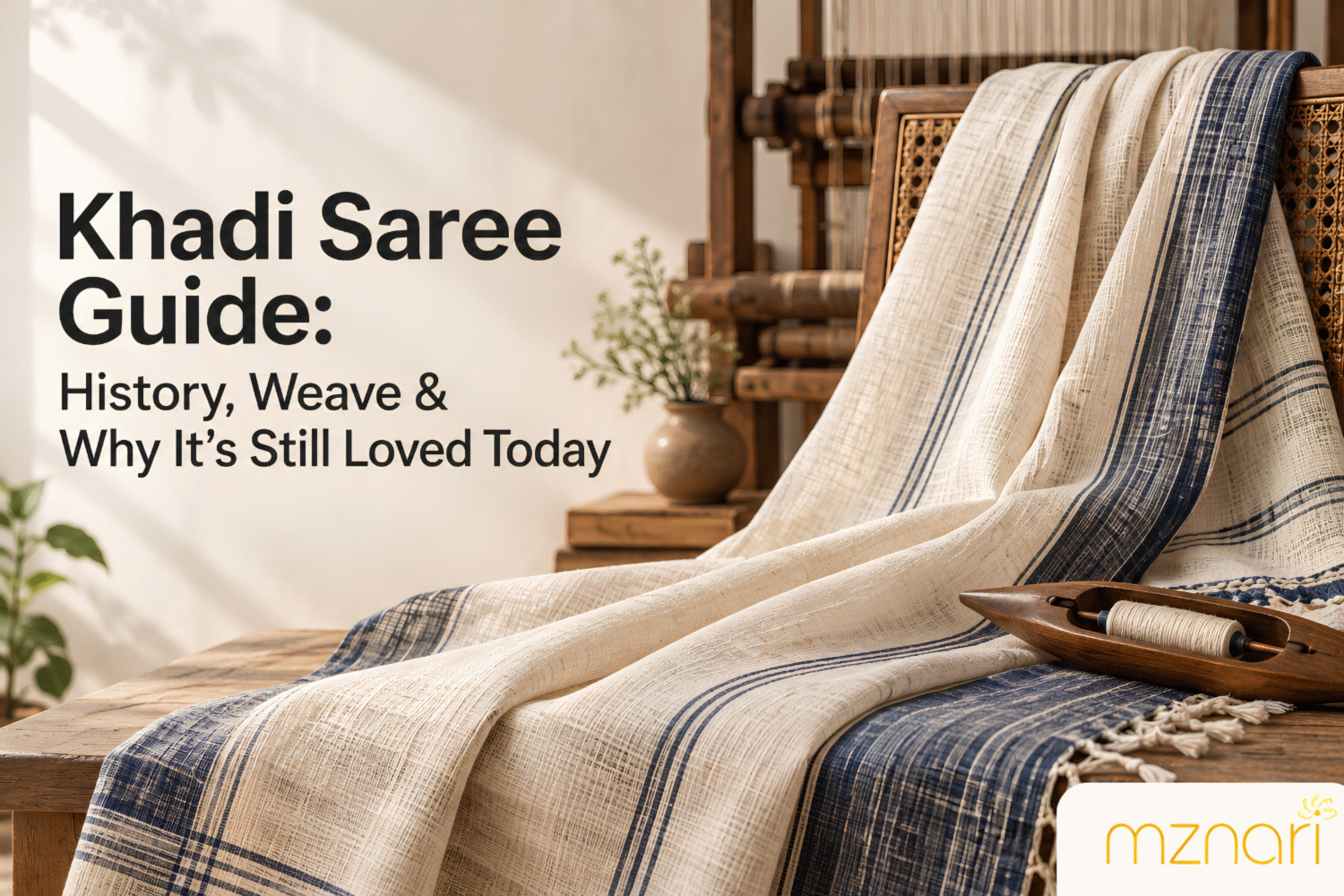
A khadi saree is a saree woven from khadi fabric — cloth that is hand-spun and handwoven, traditionally using a spinning wheel called the charkha. Unlike mill-made cotton, where yarn is spun by machines at high speed, khadi yarn is spun by hand, which gives the fabric its distinct slightly uneven, textured feel.
This is not a flaw — it’s the whole point. That subtle unevenness is what makes genuine handspun khadi immediately recognisable, and it’s also what gives the fabric its unique texture, breathability, and character that machine-made cotton simply cannot replicate.
Most khadi sarees are made from khadi cotton, though khadi silk and khadi-silk blends also exist. For this guide, we’re focusing on the classic and most-loved version: the khadi cotton saree.
The History of Khadi: A Fabric Born from a Movement
Khadi’s story goes back to India’s freedom struggle. In the early 20th century, Mahatma Gandhi encouraged Indians to spin their own cloth on the charkha instead of buying British-imported textiles. This wasn’t just about clothing — it was a symbol of self-reliance, economic independence, and quiet resistance against colonial rule.
Wearing khadi became a statement. It represented dignity, simplicity, and a rejection of dependence on foreign goods. The charkha itself became one of the most powerful symbols of India’s independence movement.
Decades later, khadi has shed its purely political identity and stepped fully into fashion — but it never lost the values it was born from. Every khadi saree still represents the same things it always has: human effort, self-reliance, and cloth made with intention rather than mass production.
How Khadi is Woven
Understanding the weave is what makes you appreciate a khadi saree even more. The process looks roughly like this:
Raw cotton is first hand-spun into yarn using a charkha. This step alone can take skilled artisans considerable time, since the yarn thickness and consistency depend entirely on the spinner’s hand movement and control. This is very different from machine spinning, where yarn is produced uniformly and rapidly.
Once the yarn is ready, it’s handwoven on a traditional handloom, thread by thread, rather than mechanically on a power loom. The weaver controls the tension, the density, and the pattern by hand throughout the process.
Because every stage — spinning and weaving — is done manually, no two khadi sarees are ever perfectly identical. Small variations in texture and weave are part of what makes each piece genuinely one-of-a-kind, not a mass-produced copy of the next.
Why Khadi Sarees Are Still Loved Today
It would be easy to assume khadi survives purely on heritage value. In reality, it’s earned its place in modern wardrobes for very practical reasons too.
Khadi is naturally breathable, which makes it genuinely comfortable to wear through long days, especially in India’s warm climate. It has a slightly textured, matte finish that photographs beautifully and looks effortlessly elegant without needing heavy embellishment. It’s also a sustainable choice — hand-spinning and handweaving use no electricity, unlike power looms, which makes khadi one of the lowest-impact fabrics in Indian textile production.
There’s also a growing appreciation for what handspun, handwoven fabric represents in an age of fast fashion. Choosing khadi means choosing a saree made by human hands, supporting traditional artisans and weaving communities directly, rather than a fabric that came off an assembly line.
Is Khadi Saree Good for Daily Wear?
Yes — and this is one of the most searched questions about the fabric. A khadi saree is a genuinely practical choice for daily wear, for a few clear reasons.
It’s breathable and cool, similar to cotton, which makes it comfortable to wear for extended hours. It has more body and structure than mul cotton, which means the pleats and pallu hold their shape well through a full day without constant readjustment. It’s also durable — genuine handwoven khadi is a strong, long-lasting fabric that only gets softer and more comfortable with wear and washing over time.
For daily wear, a plain or subtly textured khadi cotton saree with a simple blouse works beautifully for work, errands, or everyday occasions where you want to look put-together without feeling overdressed.
How to Identify Genuine Handspun Khadi Saree
Because khadi has become a popular term in fashion, not everything labelled “khadi” is genuinely handspun. A few things to check:
Look closely at the yarn — genuine handspun khadi has slight, natural irregularities in thread thickness, unlike the perfectly uniform yarn of machine-made fabric. Feel the texture — authentic khadi has a subtle textured, slightly rustic hand-feel rather than the smooth, even finish of mill cotton. Check for the weave marks — handloom weaving often leaves small, natural variations in the fabric that machine weaving does not produce. And always buy from a source that’s transparent about whether the saree is genuinely handspun and handwoven, rather than machine-made cotton simply marketed as “khadi style.”
How to Care for a Khadi Saree
Khadi is fairly low-maintenance, but a little care keeps it looking its best for years.
Hand wash in cool water with a mild detergent, especially for the first several washes. Avoid harsh wringing — gently press out water instead of twisting the fabric. Dry in shade rather than direct sunlight to protect the colour. Iron on a low to medium setting while the fabric is still slightly damp, which helps it regain its natural texture and crispness. Store folded in a breathable cotton bag rather than plastic, to prevent moisture buildup.
Frequently Asked Questions
What is the difference between khadi and cotton saree? Khadi is hand-spun and handwoven, while regular cotton sarees are typically made from machine-spun yarn, whether handwoven or power-loom woven. This is what gives khadi its distinct textured feel compared to the smoother finish of regular cotton.
Is khadi saree suitable for summer? Yes, khadi is breathable and lightweight enough to be comfortable in warm weather, similar to cotton, though it tends to have slightly more body and texture.
Can khadi sarees be worn for office wear? Absolutely. A plain or subtly patterned khadi saree paired with a simple blouse is a popular choice for office wear, since it looks polished and professional without being too formal or too casual.
Why is khadi more expensive than regular cotton? Because it is entirely hand-spun and handwoven, khadi takes significantly more time and skilled labour to produce than machine-made fabric, which is reflected in its price.
Where to Find Genuine Khadi Sarees Online
If you’re looking for a handspun khadi saree that’s genuinely handwoven rather than just labelled as one, it’s worth buying from a brand that’s transparent about its weaving process and artisan sourcing.
At Mznari by Manaris, our khadi cotton sarees are handwoven by skilled artisans, carrying forward the same values khadi has always stood for — simplicity, authenticity, and human craft. Our Lehar Collection features khadi cotton sarees with zari borders that work beautifully for both everyday wear and light festive occasions, including pieces like the Laal Lehar Khadi Cotton Saree.
Quick takeaway: Khadi isn’t just a fabric — it’s a piece of India’s history you can wear. Breathable, durable, and made entirely by hand, a khadi saree brings together heritage and everyday comfort in a way few fabrics can.