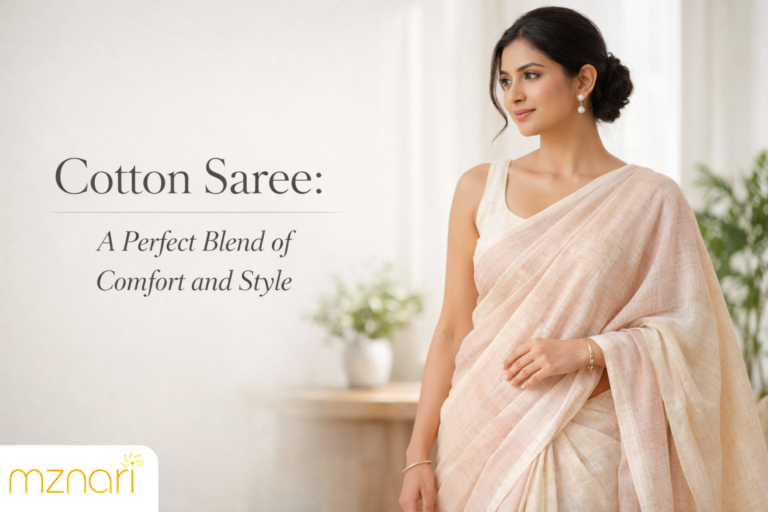
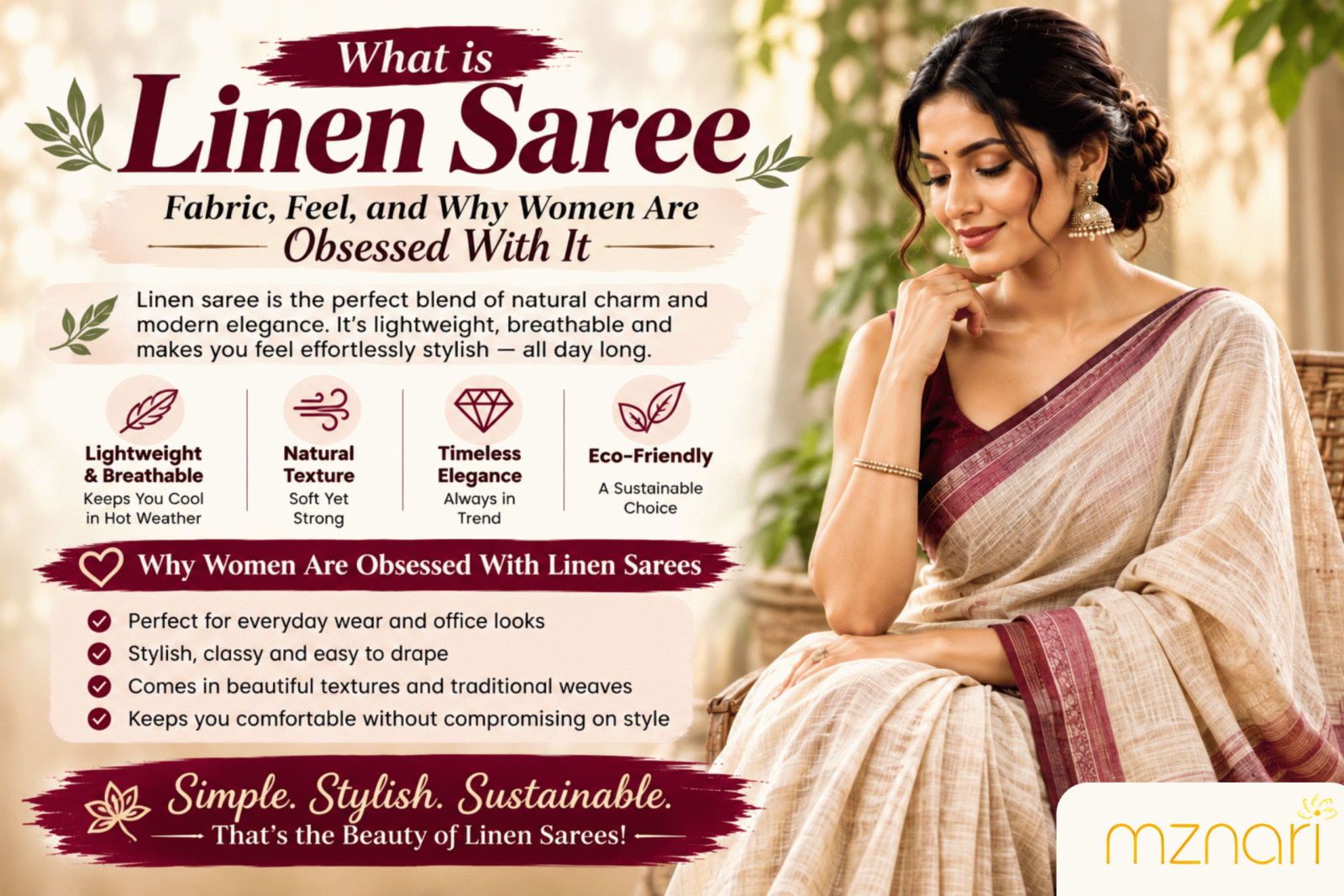
What is Linen Saree – Fabric, Feel, and Why Women Are Obsessed With It
There is a saree that working women reach for when they want to look completely put-together without trying too hard. A saree that feels cool and fresh at 2 PM on a hot afternoon when everything else feels heavy. A saree with a quiet, confident elegance that neither cotton nor silk can replicate — something in between, something of its own.
Linen has become one of the most talked-about and most loved saree fabrics among modern Indian women — and for reasons that go beyond appearance. Something about the way linen feels, drapes, and ages makes women genuinely obsessed with it once they have worn it.
This blog covers everything — what linen is, where it comes from, how a linen saree feels on the body, why it is so popular for office and summer wear, the different types available, how it compares to cotton, what the price looks like, and where to buy genuine linen sarees online in India at honest prices.
What is Linen Fabric — The Honest Explanation
Linen is one of the oldest natural fabrics in the world — and one of the most misunderstood. Many women assume it is a type of cotton or a cotton blend. It is not.
Linen is made from the fibres of the flax plant — Linum usitatissimum — a tall, slender plant grown for textile use for over 30,000 years. The fibre used to make linen comes from the stalks of the flax plant, not from a seed boll the way cotton does.
The resulting fabric has a set of physical properties that make it completely different from cotton, despite being another natural plant-based fibre:
Natural texture. Linen has a distinctive slightly rough, textured surface. This texture comes from the natural unevenness of the flax fibre — not perfectly smooth the way cotton is. The texture is not scratchy or uncomfortable — it is more like a subtle, organic roughness that gives linen its characteristic look and feel.
High strength. Linen is one of the strongest natural fibres in the world — significantly stronger than cotton of the same thickness. A linen saree, well cared for, will outlast a comparable cotton saree many times over.
Natural moisture management. Linen absorbs moisture from the skin very quickly — faster than cotton — and releases it back into the air equally fast. This makes linen one of the most effective natural cooling fabrics. In Indian summer heat, a linen saree keeps the wearer significantly more comfortable than most other fabrics.
Natural lustre. Linen has a subtle, natural sheen — very different from the bright shine of silk or the flatness of cotton. It is a quiet, understated lustre that makes linen look more elevated than plain cotton without looking overtly festive or shiny. This quality is part of why linen sarees look so naturally elegant in professional settings.
Improves with washing. Like khadi cotton, linen becomes softer and more beautiful with every wash. A brand new linen saree may feel slightly stiff or crisp. After 5 to 10 washes, the same saree will have softened into a fabric with a natural, lived-in elegance that new linen does not have.
What Does a Linen Saree Feel Like — The Most Honest Description
A linen saree feels crisp. Not stiff like a starched fabric and not rough like jute — but crisp in the way that a freshly ironed linen shirt feels. There is a structure and body to the fabric that cotton does not have. When you hold a linen saree in your hands, it stands slightly rather than draping completely limply the way mul cotton does.
Against the skin, pure linen can feel slightly rough at first — especially in the first few wears. After a few washes, this initial roughness softens considerably, and most women find that the fabric becomes progressively more comfortable over time.
The weight is light to medium — lighter than most pure silk sarees but heavier than mul cotton. The slight weight gives linen a natural, falling drape — it settles into place on the body with a structured elegance that lighter fabrics do not achieve.
The drape is one of linen’s most beautiful qualities. Because linen has body and structure, the pleats stay crisp and clean throughout the day. The pallu falls in smooth, defined folds rather than the soft, flowing folds of cotton. This crispness is part of what makes linen sarees look so polished and professional in office settings — the saree holds its shape all day without constant readjustment.
A linen-cotton blend softens both qualities. The cotton adds softness and reduces initial stiffness, while the linen adds structure and the characteristic lustre. Linen-cotton blends are generally more immediately comfortable than pure linen, making them a popular choice for beginners.
Why Women Are Obsessed With Linen Sarees — 6 Real Reasons
It photographs beautifully in natural light. Linen’s natural lustre and textured surface catch natural daylight in a very particular way — creating a soft, warm glow that looks genuinely beautiful in photographs. Women consistently report that linen sarees photograph better than most other everyday fabrics.
It looks more expensive than it is. A well-chosen linen saree has a quiet, understated elegance that looks like significantly more money than was spent on it. The natural texture and lustre create a visual richness that synthetic fabrics cannot replicate.
It is genuinely more breathable than most fabrics in Indian heat. The moisture-management properties of linen are not marketing language — they are physically real and immediately felt. Women who switch to linen sarees for office wear during Indian summer report a noticeable difference in how cool and comfortable they feel through a long workday.
It suits the modern professional aesthetic perfectly. Linen has a structured, minimal elegance that reads as modern and professional in a way that decorative or heavily printed fabrics do not. A solid linen saree in a muted tone with a simple blouse looks polished, intentional, and completely appropriate in any professional setting.
It is versatile across seasons and occasions. Unlike many fabrics that are clearly summer or winter, festive or daily — linen works comfortably across a wide range of conditions and occasions. In summer, it keeps you cool. In mild winter months, the slightly heavier weight provides enough warmth for comfortable all-day wear.
It supports sustainable and conscious fashion. Flax — the plant linen comes from — requires significantly less water to grow than cotton and can be grown without pesticides. Linen production has a lower environmental footprint than most other textile fibres. For women making conscious choices about what they buy, linen is one of the most naturally sustainable options available.
Types of Linen Sarees — What is Available and What Each Looks Like
Pure Linen Saree: Made entirely from linen fibre with no blending. Has the most pronounced linen characteristics — the most texture, the most structure, and the strongest natural lustre. Also the crispest and initially the least soft. Softens beautifully with repeated washing. Most popular for formal office wear.
Linen-Cotton Saree: A blend of linen and cotton fibres. The cotton reduces initial stiffness and adds softness while linen contributes structure, lustre, and breathability. Linen-cotton blends are the most popular and most widely available type in India — combining the best qualities of both fibres and more immediately comfortable for beginners than linen.
Linen Silk Saree: A blend of linen and silk. The silk adds a more pronounced sheen and a smoother, slightly more fluid drape. Linen silk sarees look more festive than pure linen and are often chosen for semi-formal occasions.
Bagru Print Linen Saree: A pure linen or linen-cotton blend saree with hand-block Bagru printing. The earthy natural dye prints of Bagru printing on a linen base create a saree that is both textured and artistically beautiful. The structured linen surface takes Bagru block printing very well — the prints look crisp and defined. At Mznari, Bagru print linen sarees are available starting at ₹900.
Linen Saree with Zari Border: A plain linen saree with a gold or silver zari woven border. The simple linen body with a zari border bridges daily wear and festive wear beautifully — more dressed up than plain linen but far more comfortable than a heavy embellished festive saree. Very popular for office ethnic days, temple visits, and casual family functions.
At Mznari, linen sarees start at ₹900 with 5.5 metres of saree fabric and 0.9 metres of blouse fabric included, with free shipping.
Shop: Linen Sarees by Mznari
Is Linen Saree Good for Summer — The Honest Answer
Yes — linen is one of the best saree fabrics for Indian summer. But with one important clarification most articles miss.
Linen’s breathability and moisture management are genuinely superior to most other fabrics. The hollow structure of the linen fibre creates natural air channels that allow air to circulate. This, combined with linen’s rapid moisture absorption and evaporation, means that wearing linen in heat feels cooler than wearing most other fabrics of comparable weight.
However — linen is not as light as mul cotton. Pure mul cotton is the lightest and most feather-soft summer saree fabric available. A linen saree has more body and weight than mul cotton, which some women find slightly warmer on the hottest summer days.
The ideal summer linen choice is a linen-cotton blend — the cotton content reduces weight while linen maintains breathability. For summer daily wear and office, a linen-cotton blend in a light or pastel colour is an excellent choice — cool, breathable, and professional-looking throughout the day.
Linen Saree vs Cotton Saree — The Key Differences
Feel and texture: Cotton is softer and smoother, especially mul cotton. Linen is slightly rougher and more textured — particularly when new. After multiple washes, linen softens considerably but retains its characteristic texture.
Structure and drape: Cotton drapes more softly and fluidly. Linen drapes with more body and structure — the pleats are crisper, the pallu falls in more defined folds, and the saree holds its shape better throughout the day.
Breathability: Both are breathable natural fibres. Linen is technically more breathable because of the hollow structure of the flax fibre. In practical terms, both are significantly more breathable than synthetic sarees.
Appearance: Cotton has a matte, flat appearance. Linen has a subtle natural lustre that gives it a more elevated, polished look. This visual difference is why linen looks more office-appropriate than plain cotton even in a simple solid colour.
Occasion suitability: Cotton excels at casual daily wear, travel, and home wear. Linen excels at office wear, professional settings, and semi-formal occasions where you want to look structured and put-together.
Durability: Linen is stronger and more durable than cotton. A well-cared-for linen saree will outlast a comparable cotton saree. Linen’s strength actually increases when wet, which means repeated washing does not weaken it the way it eventually weakens cotton.
Price: At comparable quality levels, linen is usually slightly more expensive than cotton. At Mznari, linen sarees start at ₹900 — only slightly above mul cotton at ₹799.
How to Style a Linen Saree — Complete Guide
For office and professional settings: A solid linen saree in a muted or neutral tone — warm beige, dusty sage, stone grey, slate blue, or natural off-white — with a simple, well-fitted cotton or silk blouse in a slightly deeper contrast shade. Keep jewellery minimal — one pair of small earrings and a simple bangle is all needed. The linen fabric provides all the visual interest the outfit requires.
For casual and weekend wear: A Bagru print linen saree in earthy tones — indigo and cream, rust and black, mustard and brown — with a plain cotton blouse in one of the print colours. Oxidised silver earrings and simple sandals complete the look.
For semi-festive occasions: A linen saree with a zari border in a richer colour — deep teal, forest green, warm burgundy — with an embroidered or embellished blouse looks appropriately dressed up for small festive occasions and office ethnic days.
Jewellery for linen sarees: The natural, organic quality of linen pairs most beautifully with handcrafted, artisanal jewellery — oxidised silver, terracotta, wooden, or simple gold. For office, small pearl or gold studs are perfect. For casual linen sarees, oxidised silver jhumkas look naturally harmonious.
Linen Saree Price Guide — What to Expect at Different Budgets
₹900 – ₹1,500 — Entry-level and mid-range linen-cotton blend sarees in solid colours or simple Bagru block prints. The linen content gives the characteristic texture and structured drape while cotton keeps them soft and affordable. At Mznari, linen sarees start at ₹900 with free shipping and blouse fabric included.
₹1,500 – ₹2,500 — Higher linen content sarees with more refined texture, better natural lustre, and more design options, including zari borders and more complex Bagru prints. Very popular for office wear.
₹2,500 – ₹4,000 — Pure linen sarees with higher thread count, finer texture, and more sophisticated weaving. These look and feel noticeably more premium and are excellent for formal office environments and semi-festive occasions.
₹4,000 and above — Premium pure linen sarees, linen silk sarees, and linen sarees with significant handloom craftsmanship. Investment pieces with excellent longevity.
Shop all linen sarees → mznari.in/product-category/linen/
How to Care for a Linen Saree
Washing: Hand wash or machine wash on a gentle cycle in cold water. Linen is a strong fabric and handles washing well. Use a mild detergent. For the first few washes, wash separately as some natural dyes may release slightly.
Drying: Dry in shade. Remove from the wash while still slightly damp and straighten the fabric before hanging — this reduces creases and makes ironing easier.
Ironing: Iron while slightly damp on medium to high heat. Linen responds very well to ironing and looks beautifully crisp and fresh after a good iron — and holds its pressed appearance for significantly longer than cotton through a workday.
Storing: Fold neatly and store in a cotton cloth or saree bag. Never store in plastic. Refold occfasionally if storing for a long time to prevent permanent crease marks.
What to expect with age: Linen sarees soften and become more beautiful with every wash. A linen saree you have owned for two years will have a softer, more lived-in elegance than it did when new.
Frequently Asked Questions (FAQ)
- What is a linen saree? A linen saree is a saree woven from linen fabric — a natural textile made from the fibres of the flax plant. Linen has a distinctive, slightly rough texture, natural lustre, and excellent breathability that makes it one of the most comfortable and elegant everyday saree fabrics for Indian women.
- Is linen saree good for summer? Yes — linen is one of the best fabrics for Indian summer. Its hollow fibre structure allows air to circulate, and its moisture absorption and evaporation rate are higher than most other fabrics, keeping the wearer cool and fresh in Indian summer heat. A linen-cotton blend saree is the most comfortable summer option.
- What is the difference between linen and cotton sarees? Cotton is softer and more fluid in drape. Linen is slightly rougher with more structure and body — the pleats are crisper, the drape is more defined, and the saree holds its shape better. Linen has a natural lustre that cotton does not and looks more elevated and professional. Linen is also more durable than cotton.
- Is a linen saree good for office wear? Linen is one of the best fabrics for office sarees. Its structured drape looks neat and polished all day. The natural lustre looks elevated and professional without being shiny. A solid linen saree in a muted tone is one of the most appropriate and comfortable office saree choices available.
- What is the price of linen sarees in India? Linen sarees at Mznari start at ₹900 for linen-cotton blends in solid or Bagru print styles. Mid-range pure linen sarees with zari borders range from ₹1,500 to ₹2,500. Premium pure linen and linen silk sarees start from ₹2,500 and above.
- What is a linen-cotton saree? A linen-cotton saree is a saree woven from a blend of linen and cotton fibres. The cotton adds softness and reduces linen’s initial stiffness, while the linen contributes structure, natural lustre, and better breathability than pure cotton. Linen-cotton blends are the most popular linen saree type for everyday and office wear.
- Does linen saree shrink after washing? Pure linen can shrink slightly in the first one or two washes — normal for all natural fibres. After the first two washes, the fabric stabilises. Always wash in cold water to minimise any initial shrinkage.
- Where can I buy linen sarees online in India at affordable prices? Mznari offers linen sarees — including Bagru print linen and solid linen-cotton blends — starting at ₹900 with free shipping, easy 15-day returns, and blouse fabric included. Shop at mznari.in/product-category/linen/
Final Thoughts — The Saree That Gets Better Every Time You Wear It
Most fabrics are at their best when new and gradually deteriorate over time. Linen is the opposite. It gets better. Softer. More beautiful. More naturally elegant with every wash and every wear.
A woman who owns a good linen saree for two years wears it more confidently and more often at the end of those two years than she did at the beginning — because the fabric has settled into a softness and character that new linen does not have.
That relationship between a woman and a good linen saree — the gradual softening, the easy comfort, the way it always looks right for office — is exactly why women who discover linen sarees become genuinely obsessed with them.
At Mznari, linen sarees starting at ₹900 are available in Bagru print and solid styles — all with free shipping, blouse fabric included, and easy 15-day returns.
Shop linen sarees online → mznari.in/product-category/linen/
Free Shipping | Easy 15-Day Returns | Blouse Fabric Included | Starting ₹900
Related reads: → Chanderi vs Kota Doria – Which Lightweight Saree is Right for You → What is Bagru Printing – How It is Done and Why It is Special → Best Sarees to Wear in Summer – Stay Cool and Look Stunning → Best Khadi Cotton Saree for Office Wear in India → How to Build a Complete Saree Wardrobe on a ₹5000 Budget